
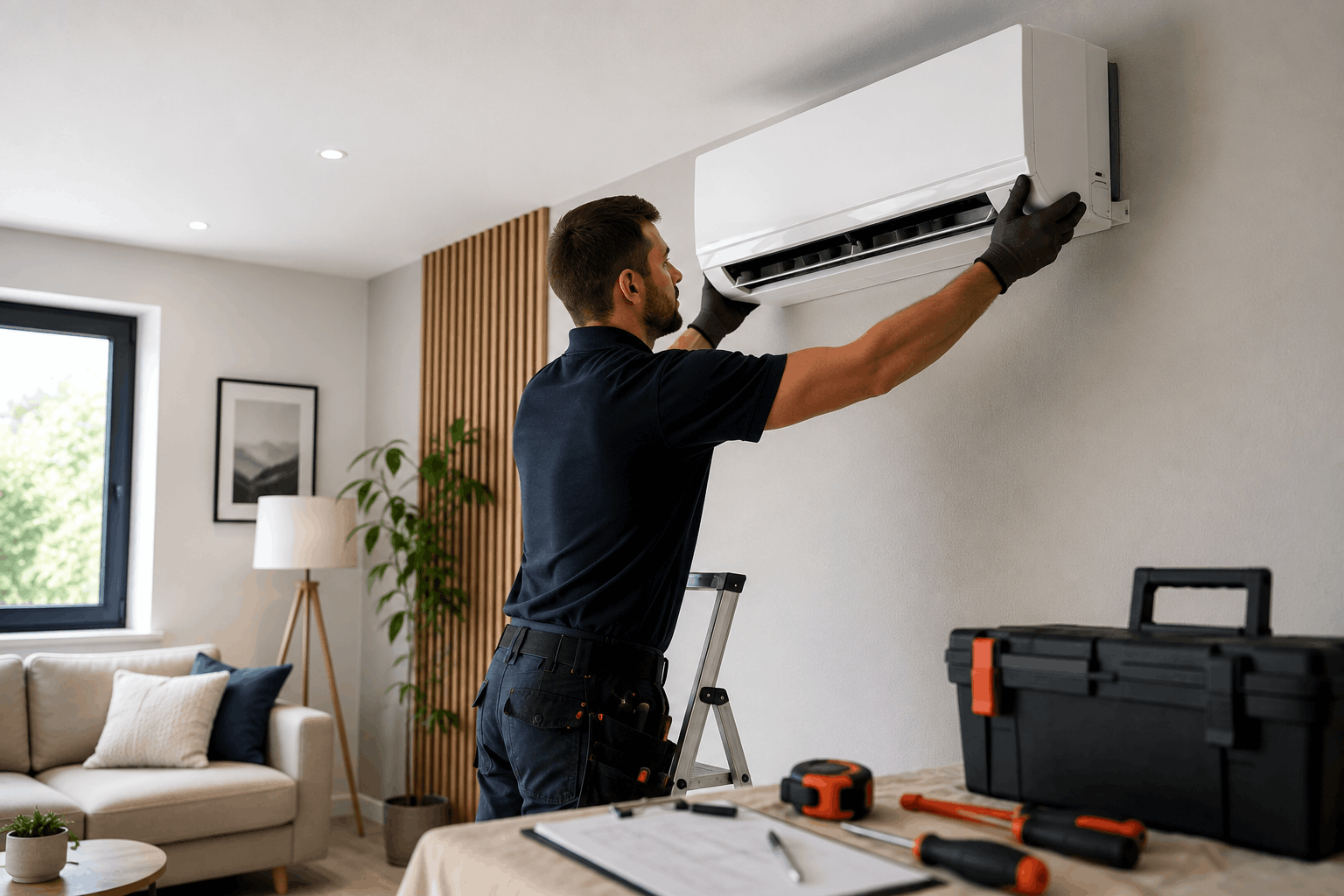
Air conditioning used to feel like something you’d mainly find in offices, hotels and shops. That’s changing. With warmer summers, better-insulated homes and more people working remotely, fixed air conditioning is becoming a practical home improvement for UK homeowners.
So, how much does air conditioning installation cost? For a typical UK home, a straightforward single-room split air conditioning installation will often cost around £1,500 to £3,000, while multi-room systems can run from roughly £3,000 to £7,000 or considerably more depending on the number of rooms, system specification and complexity of the installation.
Those figures are best treated as a starting point rather than a guaranteed quote. The size of your home, the type of air conditioner, pipe runs, electrical work and even where the outdoor unit can be positioned can make a noticeable difference.
Average Air Conditioning Installation Costs
For homeowners trying to set a sensible budget, the type and scale of the system matter more than almost anything else.
Typical indicative costs might look something like this:
|
Air Conditioning System |
Approximate Installed Cost |
|
Single-room split system |
£1,500–£3,000 |
|
Two-room multi-split system |
£2,500–£4,500 |
|
Three-room multi-split system |
£3,500–£6,000 |
|
Larger multi-room installation |
£5,000–£10,000+ |
|
Ducted residential system |
£5,000–£12,000+ |
These aren’t fixed UK tariffs. Installation companies price jobs individually, and equipment specifications vary considerably between manufacturers.
A simple bedroom installation, for example, may require relatively little pipework and straightforward access to an external wall. Cooling several bedrooms and a downstairs living area is a different project entirely.
What Does the Installation Price Usually Include?
When comparing quotes, don’t look only at the price of the air conditioning unit itself. A professionally installed system involves considerably more than mounting a machine on the wall.
A typical quote may include:
- Indoor and outdoor air conditioning units
- Refrigerant pipework between the units
- Condensate drainage
- Electrical connections and isolators
- Wall brackets or outdoor mounting equipment
- Drilling and installation work
- System testing and commissioning
- Controls or a standard remote
- Labour and installation materials
Exactly what’s included varies between installers.
This matters when comparing two quotes. A £1,700 quotation that excludes additional electrical work isn’t necessarily cheaper than a £2,000 quotation covering the complete installation.
Ask for an itemised quote wherever possible.
What Affects Air Conditioning Installation Cost?
Two homeowners can install apparently similar systems and receive quite different quotes. Usually, there’s a practical reason.
Number of Rooms
A single-room system is normally the cheapest option.
If you want air conditioning throughout the house, you’ll need either several individual systems, a multi-split arrangement connecting multiple indoor units to an outdoor unit, or potentially a ducted system.
Every additional room increases the amount of equipment, pipework and labour required.
That doesn’t necessarily mean you need air conditioning everywhere. Many homeowners concentrate on the rooms that become particularly uncomfortable during hot weather, such as:
- South-facing bedrooms
- Loft conversions
- Home offices
- Conservatories or garden rooms
- Open-plan kitchens and living spaces
Targeting the rooms where cooling matters most can keep the initial cost under control.
Size and Cooling Requirement
Buying the smallest unit available isn’t automatically the cheapest long-term solution.
An air conditioning system needs to be appropriately sized for the room. Installers consider factors such as room dimensions, insulation, glazing, orientation and heat generated by occupants or equipment.
A large open-plan kitchen with extensive glazing, for instance, may have a very different cooling requirement from a bedroom of similar floor area.
Correct sizing is therefore more important than simply choosing a unit based on price.
Type of Air Conditioning System
The system you choose has a major effect on your budget.
Single-Split Air Conditioning
A single-split system normally consists of one indoor unit connected to one outdoor unit.
It’s a popular solution for bedrooms, living rooms and home offices because it’s relatively straightforward and allows you to cool one important area without installing air conditioning throughout the property.
For homeowners primarily concerned about one excessively warm bedroom, this can offer good value.
Multi-Split Air Conditioning
A multi-split system allows several indoor units to operate from one outdoor unit.
It can be a neater solution when cooling multiple rooms because you don’t necessarily need a separate outdoor condenser for every indoor unit.
However, installation becomes more complicated. Longer refrigerant pipe runs, additional indoor units and system design all add to the overall cost.
Ducted Air Conditioning
Ducted systems can provide a particularly discreet appearance because conditioned air is distributed through ducts and vents rather than relying on prominent wall-mounted units.
The trade-off is cost and complexity.
Ceiling voids, ductwork, access requirements and building alterations can make these installations considerably more involved, particularly when retrofitting an existing house.
Installation Complexity Can Change the Quote
The equipment is only part of the bill.
Imagine two homeowners buying the same wall-mounted air conditioner.
In the first property, the indoor unit sits directly opposite a suitable external location for the condenser. The installer has easy access and only needs a short pipe run.
In the second property, the indoor unit is upstairs at the front of the house while the condenser needs to be positioned elsewhere. Pipework has to travel a greater distance, drainage is less straightforward and access requires additional equipment.
The second installation will naturally cost more even though the air conditioner itself is identical.
Common factors that can increase labour or material costs include:
- Long refrigerant pipe runs
- Difficult access
- Additional electrical work
- Condensate pumps
- Complex drainage arrangements
- High-level outdoor units
- Decorative pipework concealment
- Multiple indoor units
- Structural or building alterations
This is why an on-site survey can provide a much more useful estimate than a generic online price.
Does VAT Apply to Home Air Conditioning Installation?
This is an area where homeowners should be careful because the tax treatment can depend on the equipment and installation.
Current HMRC guidance states that qualifying air-source heat pumps installed in residential accommodation can benefit from temporary 0% VAT until 31 March 2027. HMRC also notes that it considers most air conditioning units to be air-source heat pumps, although whether a particular product qualifies depends on the facts of the installation.
The distinction is important. You shouldn’t simply assume that every air conditioning quote automatically qualifies for 0% VAT.
Ask the installer whether the proposed system qualifies and whether VAT has already been accounted for in the quotation.
Can You Get Financial Help Towards Installation?
There’s another potentially important development for homeowners considering systems capable of both heating and cooling.
Under the Boiler Upgrade Scheme, eligible property owners in England and Wales can currently receive £2,500 towards the cost and installation of an air-to-air heat pump. Eligibility requirements apply, so this shouldn’t be treated as an automatic discount on every domestic air conditioning installation.
If you’re considering a reverse-cycle air conditioning system primarily as part of a wider heating and cooling strategy, it’s worth checking whether the proposed installation meets the scheme requirements before accepting a quote.
Are Systems That Provide Heating More Expensive?
Many modern fixed air conditioning systems can work in reverse, meaning they can provide heating as well as cooling.
HMRC’s guidance specifically recognises that fixed air-source heat pumps can be reversed to draw heat from inside a building during summer, providing cooling as well as heating during colder periods.
For UK homeowners, this can make the system more useful throughout the year.
Instead of spending several thousand pounds on equipment that’s useful only during a handful of particularly hot weeks, a suitable reverse-cycle system can potentially provide supplementary heating during cooler weather too.
That doesn’t automatically mean it should replace your existing central heating system. Whether that’s sensible depends on the property, system design, insulation and heating requirements.
What About Running Costs?
Installation cost is only one side of the calculation.
Air conditioning uses electricity, so running costs depend on:
- System efficiency
- Electricity tariff
- Outdoor temperature
- Desired indoor temperature
- Number of rooms being cooled
- How many hours the system operates
- Property insulation
- Unit sizing and maintenance
It’s difficult to give one meaningful hourly running-cost figure because systems and electricity tariffs vary.
A better comparison is the unit’s efficiency information and expected usage. Ask your installer for the proposed model numbers and efficiency ratings rather than relying purely on the purchase price.
Using the system sensibly matters as well. Trying to turn a hot room into a refrigerator isn’t particularly useful and will increase energy consumption.
Additional Costs Homeowners Often Overlook
A basic advertised installation price doesn’t always represent the final project cost.
Before accepting a quote, find out whether you’ll need to pay extra for electrical upgrades, longer-than-standard pipe runs, scaffolding or specialist access, condensate pumps, decorative trunking, Wi-Fi controls or removal of an existing system.
Planning requirements may also need consideration depending on the property and proposed location of external equipment. Listed buildings, flats and properties subject to particular restrictions deserve additional attention before work begins.
Checking these details beforehand is far better than discovering them halfway through the installation.
Is It Cheaper to Install Air Conditioning During a Renovation?
Potentially, yes.
If you’re already renovating, extending or converting a loft, it may be easier to accommodate pipework, electrical cables, drainage and concealed equipment before walls and ceilings are finished.
Retrofitting the same system afterwards can require additional labour simply to route everything neatly around the completed interior.
For homeowners planning a substantial renovation, discussing air conditioning early with both the installer and builder can therefore be worthwhile.
How to Reduce Air Conditioning Installation Costs
Reducing the cost doesn’t mean buying the cheapest equipment available.
Start by deciding which rooms genuinely need cooling. Installing units throughout the house simply because you can may add thousands of pounds without delivering much additional benefit.
Then obtain several comparable quotations based on the same requirements.
When reviewing them, check:
- Exact make and model being supplied
- Number and capacity of indoor units
- Outdoor unit specification
- Pipework allowance
- Electrical work included
- Warranty details
- Controls included
- Labour and commissioning
- VAT treatment
- Potential additional charges
A surprisingly cheap quotation deserves the same scrutiny as an expensive one.
The goal isn’t to find the lowest number at the bottom of the page. It’s to understand what you’re actually getting for your money.
Is Home Air Conditioning Worth the Cost?
That depends heavily on your property and how you use it.
If one bedroom becomes uncomfortable for a few nights each year, spending thousands on whole-house air conditioning probably won’t make financial sense.
The calculation looks different if you have a south-facing modern home, heavily glazed extension, converted loft or home office that regularly overheats.
Heating capability can also improve the value you get from the installation because the equipment may be useful beyond summer.
Think about comfort, frequency of use, energy efficiency and the rooms that actually need temperature control rather than treating air conditioning as an all-or-nothing home improvement.
Getting an Accurate Air Conditioning Installation Quote
Online averages are useful for establishing a budget, but they can’t account for the layout of your house.
A professional installer should assess the rooms you want to cool, calculate the appropriate system capacity, identify suitable indoor and outdoor unit locations and consider pipework, drainage and electrical requirements.
Make sure the quotation clearly explains what’s included and highlights any circumstances that could lead to additional charges.
Conclusion
So, how much does air conditioning installation cost in the UK? A straightforward single-room installation will commonly fall somewhere around £1,500 to £3,000, while multi-room systems can easily reach £3,000 to £7,000 or more. Larger or ducted installations may exceed £10,000 where substantial equipment and building work are required.
The number of rooms matters, but it isn’t the whole story. System capacity, pipework, outdoor-unit positioning, electrical requirements and installation difficulty can all move the final price considerably.
Rather than choosing an installer purely on the cheapest quote, compare exactly what’s being supplied and how the system has been designed for your property. A properly sized, thoughtfully positioned system is far more likely to deliver the comfort and efficiency you’re paying for.